

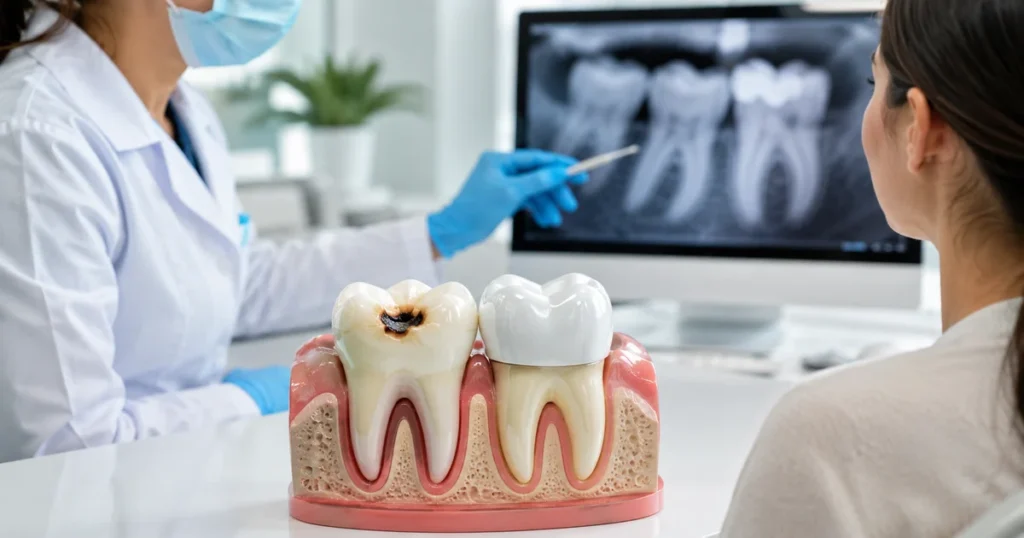
A filling is usually enough when the damaged area is limited, and the tooth still has strong walls around it. A dental crown may be recommended when a large cavity, crack, previous restoration, or root canal has left the tooth at risk of breaking. A dental crown vs filling assessment usually begins with an examination and dental X-rays. For smaller cavities, cavities and fillings can restore the missing portion without covering the entire tooth.
The sections below explain the clinical signs associated with each restoration, how dentists assess the remaining tooth structure, and what may happen if a weakened tooth receives a filling that cannot support normal biting pressure.
Do I Need a Crown or Just a Filling?
The answer depends less on the visible size of the hole and more on the strength of the tooth after all decay or damaged material has been removed.
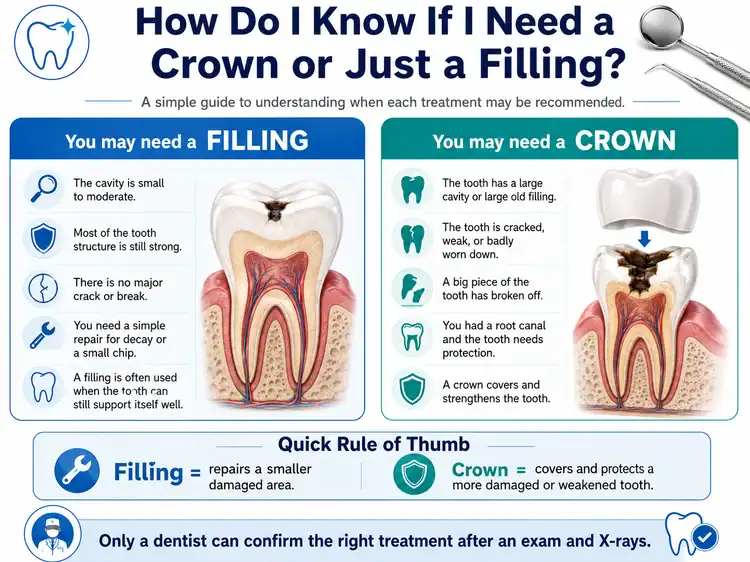
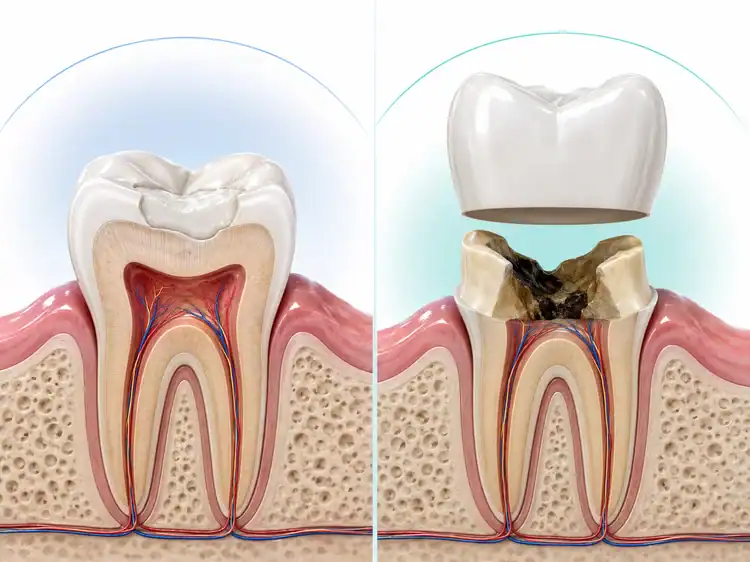
A filling replaces a specific missing area. It relies on the surrounding tooth for support. A crown covers the visible portion of the tooth and helps hold weakened sections together.
A filling is usually suitable when the damaged area is small or moderate and enough healthy tooth remains to support the restoration. A crown may be recommended when decay, cracks, previous fillings, or wear have weakened the tooth and increased the risk of fracture. The table below shows the main differences dentists consider.
| A Filling Is Usually Enough When | A Crown May Be Needed When |
|---|---|
| The cavity is small or moderate. | The cavity covers a large part of the biting surface. |
| Most of the natural tooth remains intact. | A large amount of tooth structure has been lost. |
| The cusps are thick enough to resist biting pressure. | One or more cusps are broken, thin, or weakened. |
| There is no significant crack in the tooth. | A crack has weakened the tooth. |
| An old filling can be replaced without removing much additional tooth structure. | The tooth already contains a very large filling. |
| The tooth still has adequate support across its surfaces. | The same restoration has been replaced several times. |
| A minor chip can be repaired with bonding to stable enamel. | Grinding or heavy wear has reduced the strength of the tooth. |
| The restoration can be completed without placing excessive force on the remaining walls. | A back tooth has received root canal treatment. |
| The remaining tooth can hold the filling securely. | Too little tooth remains to support a filling reliably. |
Direct fillings are commonly completed during one appointment after the dentist removes the decay and prepares the tooth. They can also repair some minor chips when enough stable enamel remains for bonding.
A crown covers the remaining part of the tooth above the gum line and helps support weakened walls and cusps. It may be recommended for teeth affected by severe decay, fractures, defective large fillings, or previous root canal treatment.
Why Tooth Structure Matters Most
Healthy enamel and dentin distribute biting forces through the tooth. A small filling works within that structure. As a cavity becomes larger, the walls and cusps around the restoration become thinner.
A large filling does not automatically strengthen those remaining walls. In some cases, the filling may act like a wedge during chewing. This can increase stress on a weakened cusp.
The dentist therefore evaluates the amount of sound tooth remaining after decay removal. The location of that structure also matters. A tooth may appear mostly intact from one angle, while a crack or deep cavity has weakened the area below the surface.
Crown vs Filling Comparison Table
| Factor | Dental Filling | Dental Crown |
|---|---|---|
| Main purpose | Replaces a limited area of decay or damage | Covers and protects a weakened tooth |
| Best suited for | Small or moderate cavities with strong surrounding structure | Large cavities, cracks, broken cusps, or heavily restored teeth |
| Tooth coverage | Repairs only the prepared area | Covers most or all of the visible tooth |
| Tooth preparation | Usually removes less natural tooth | Requires shaping the tooth for crown placement |
| Appointment time | Commonly completed in one visit | Often requires two visits, depending on the crown system |
| Relative cost | Usually lower | Usually higher due to added preparation and laboratory work |
| Structural support | Depends heavily on the remaining tooth walls | Helps hold weakened sections together |
| Root canal use | May be appropriate for selected teeth with adequate structure | Commonly used for root canal-treated back teeth |
| Future repair | May be repaired or replaced if enough tooth remains | May require recementation or replacement if it wears or loosens |
Most direct fillings can be completed during one appointment. Laboratory-made crowns commonly require two or more appointments, although some dental offices use systems that can produce a crown during a single visit.
Signs You May Need a Filling
Symptoms cannot confirm the type of restoration by themselves, but the following concerns are often associated with a cavity that may still be suitable for a filling:
- Mild sensitivity to cold or sweet foods
- A small visible hole
- Food is collected in one area
- A minor chip without deeper fracture lines
- An old filling with a small damaged edge
- Decay found during a routine dental examination
- A dark area detected between teeth on an X-ray
Early cavities may cause little or no discomfort. Dental X-rays can reveal decay between teeth or below areas that cannot be assessed fully during a visual examination.
Pain does not always indicate cavity size. A small cavity near the dental pulp may cause significant sensitivity, while a much larger cavity can remain quiet until the tooth becomes infected.
Read more: Eating after a dental filling
Signs You May Need a Crown
A crown may be considered if you notice:
- A large portion of the tooth has broken away.
- A cusp moves or feels unstable.
- The tooth hurts when you bite down.
- Pain occurs when you release your bite.
- A large filling occupies most of the tooth.
- The tooth has fractured around an old restoration.
- A crack is visible across the surface.
- The tooth has undergone root canal treatment.
- Part of the tooth repeatedly breaks despite previous repairs.
Pain during biting can be associated with a crack, but it can also have other causes. A clinical examination is needed because cracks vary in depth and location.
Some cracks affect only the outer enamel. Others extend deeper and may reach the dental pulp or root. A crown may protect a restorable cracked tooth, but a severe crack below the gum line can limit the available treatment options.
How Dentists Decide Between a Crown and a Filling
The dentist begins by examining the tooth and the surrounding gum. The assessment may include several parts.
- Visual examination: The dentist checks the size of the cavity, the condition of existing fillings, and the thickness of the remaining tooth walls.
- Dental X-rays: can show decay between teeth, changes near the root, and the depth of a cavity. They also help identify infection around the tooth.
- Bite assessment: The dentist may ask you to bite on a small instrument. Localized pain can help identify a weakened cusp or crack.
- Removal of damaged material: The full extent of the damage sometimes becomes clear only after an old filling or decayed area has been removed. A tooth that initially appears suitable for another filling may have less healthy structure underneath.
- Evaluation of the dental pulp: Cold testing or other pulp tests may be used if the tooth is painful. If decay has reached the pulp, root canal treatment may be needed before the final restoration.
- Assessment of biting pressure: Back teeth carry greater chewing forces than front teeth. Tooth grinding and a heavy bite can also influence the choice of restoration.
A dentist may occasionally recommend an inlay or onlay instead of a full crown. These laboratory-made restorations cover more area than a direct filling but preserve more of the natural tooth than a traditional crown in suitable cases.
According to Cleveland Clinic, a dental filling is generally suitable for a small cavity or minor tooth damage, while a dental crown may be needed when the cavity is larger, the tooth is fractured, or additional strength and protection are required.
What Happens If a Filling Is Not Strong Enough?
An undersized restoration plan does not always fail immediately. The filling may initially feel normal while the remaining tooth structure continues to flex under biting pressure.
Possible outcomes include:
- A cusp breaking away
- A crack is becoming deeper
- The filling loosening
- Leakage around the restoration
- New decay forming at the edge
- Irritation or infection of the dental pulp
- Loss of enough structure to complicate crown placement
- A fracture that makes the tooth difficult to save
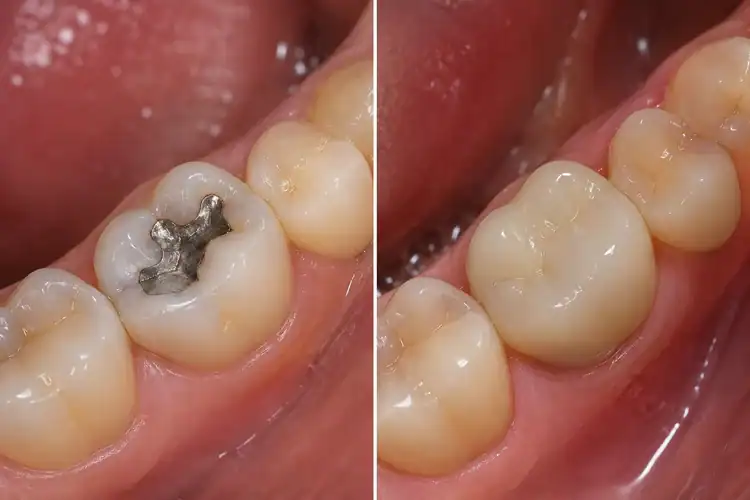
Older fillings can weaken, fracture, or leak around their margins. Bacteria may collect in these gaps and contribute to new decay.
This does not mean that every large filling will fail. The concern is the relationship between the restoration and the remaining tooth. A dentist recommends a crown when the risk of structural failure appears too high for another direct filling.
Does Your Tooth Need a Crown or a Filling?
A dental examination can determine how much healthy tooth remains and which restoration offers suitable support. Contact Tsawwassen Family Dental to book an assessment for a painful, chipped, decayed, or heavily filled tooth.
When to See a Dentist
Book a dental examination if a tooth is chipped, painful, sensitive, or losing pieces. You should also arrange an appointment after a filling falls out, even if the tooth is not painful.
Contact a dentist promptly if you have:
- Pain while biting
- Persistent sensitivity
- A visible crack
- A sharp broken edge
- A loose filling
- A broken cusp
- Throbbing pain
- Swelling near the tooth
A chipped or fractured tooth should be assessed because treatment may range from a small filling to a crown. More extensive damage may involve the dental pulp.
Facial swelling, fever, or signs of spreading infection require urgent dental attention. Rapid swelling of the tongue or throat, difficulty breathing, or difficulty swallowing requires emergency medical care.
Conclusion
A filling is often appropriate when enough healthy tooth remains to support it. A crown becomes more likely when decay, cracks, or previous dental work have left the tooth structurally weak. The most important factor is the condition of the tooth after the damaged material has been removed.
Tsawwassen Family Dental can examine the tooth, review the X-rays, and explain which restorative dentistry option offers suitable protection. Early assessment may preserve more natural tooth structure and reduce the chance of a larger fracture.
FAQ
The following answers address common concerns about dental crowns and fillings.
-
Can a Large Cavity Be Fixed With a Filling?
Some large cavities can be restored with a filling, but the surrounding tooth must be strong enough to support it. A crown may be recommended if the remaining walls or cusps are too thin.
-
Is a Crown Always Needed After a Root Canal?
A crown is common after root canal treatment on a molar or premolar because these teeth carry substantial chewing pressure. A front tooth may sometimes be restored with a filling if enough structure remains. The recommendation depends on the tooth’s location and condition.
-
Is a Crown Better Than a Filling?
A crown is not automatically better. A filling preserves more natural tooth and is often appropriate for limited damage. A crown provides broader protection when the tooth has become too weak for a filling.
-
How Do Dentists Decide Between a Crown and a Filling?
The dentist evaluates the cavity size, remaining tooth structure, existing cracks, bite pressure, and dental X-rays. The condition of the tooth after decay removal often determines the final recommendation.
-
What Happens If I Delay Getting a Crown?
The weakened tooth may remain stable for a period, but it can also fracture under normal chewing pressure. A deeper fracture may require more extensive treatment and can sometimes make the tooth impossible to restore.