

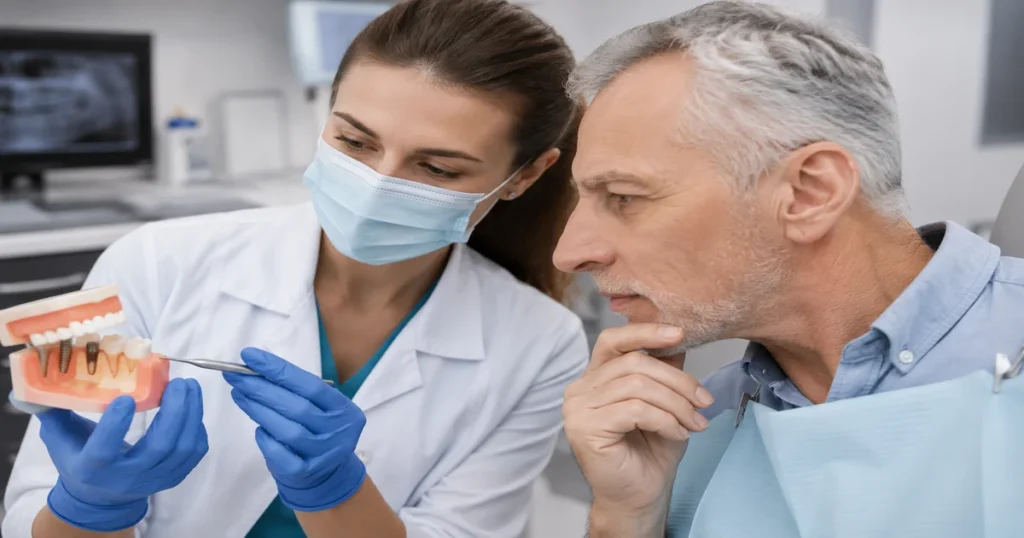
The main signs you need a dental bridge instead of a denture are a short, contained gap and teeth beside it that can carry the restoration. A bridge may also be suitable if movement from a removable partial denture affects chewing or speech.
A dentist must examine the supporting teeth, gum health, bite, and location of the gap before recommending treatment. The sections below compare both options and explain why a denture may still be the better choice in some cases.
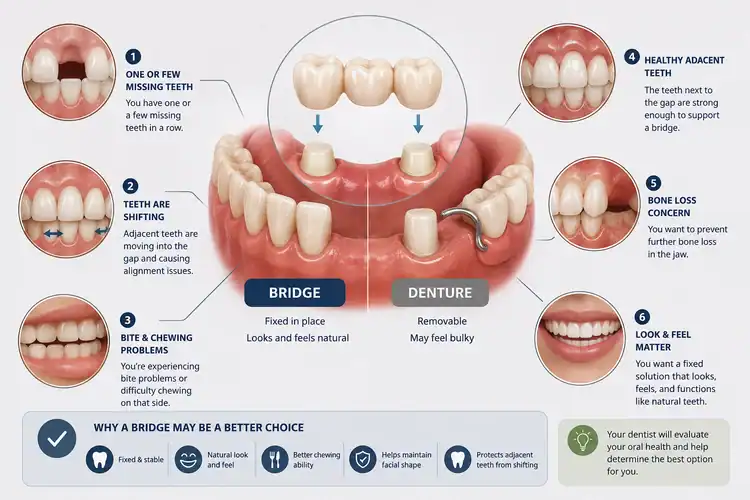
Signs You Need a Dental Bridge Instead of a Denture
A dental bridge is a fixed restoration that replaces missing teeth with artificial teeth called pontics. A traditional bridge is commonly supported by crowns placed over teeth on each side of the gap. Unlike a removable denture, a bridge remains fixed in the mouth and can only be removed by a dentist.
You Are Missing One or a Few Teeth in One Area
A bridge is most commonly considered when one tooth or a short row of neighbouring teeth is missing. This creates a contained space that can be restored with support on either side.
Bridges are often used for one to three adjacent missing teeth, although the safe length depends on the location of the gap and the strength of the supporting teeth. A longer bridge places greater force on the abutment teeth and may require a different treatment plan.
Your Neighbouring Teeth Can Support a Bridge
The teeth beside the gap must be healthy enough to function as abutment teeth. They need adequate tooth structure, stable roots, and sufficient bone support.
A traditional bridge requires the dentist to reshape the supporting teeth so that dental crowns can fit over them. Teeth with extensive decay, fractures, advanced gum disease, or poor bone support may not provide a reliable foundation.
A bridge can sometimes be a logical choice when the neighbouring teeth already need crowns. The crowns can restore those teeth while supporting the pontic between them. Placing crowns on completely healthy teeth requires more consideration because natural tooth structure must be removed.
Dental Bridge vs Denture Comparison Table
| Factor | Dental Bridge | Removable Partial Denture |
|---|---|---|
| Type of restoration | Fixed in the mouth | Removed by the patient |
| Common use | One tooth or a short row of missing teeth | Several missing teeth or gaps in different areas |
| Support | Natural teeth or dental implants | Gums, remaining teeth, or implants |
| Movement | Usually stable during chewing | May move slightly during use |
| Effect on nearby teeth | Traditional bridges require preparation of supporting teeth | Usually uses clasps and requires less tooth reduction |
| Cleaning | Must be cleaned beneath the pontic | Removed for cleaning |
| Adjustment period | Usually less bulky after placement | May initially affect speech or chewing |
| Replacement of lost gum tissue | Limited ability to replace extensive gum loss | Acrylic can replace missing gum volume |
| Treatment complexity | Requires suitable abutment teeth or implants | Can often be used when fixed support is limited |
| Repair or modification | Usually requires dental treatment | May be easier to adjust or add teeth to in selected cases |
Partial dentures may be recommended when the nearby teeth cannot support a bridge or when more than a few teeth are missing.
Problems With Removable Dentures That a Bridge May Solve
A well-designed partial denture can restore chewing and appearance, but some patients experience problems related to its removable design.
A bridge may help with:
- Movement during chewing
- Pressure against the gums
- Visible metal clasps
- Food collecting beneath the denture base
- Difficulty speaking with a bulky appliance
- The need to remove the appliance for cleaning
- Discomfort caused by an unstable fit
A loose denture does not automatically mean that a bridge is required. The denture may need an adjustment, reline, repair, or replacement. Gum and jawbone contours can change after tooth loss, which may alter the fit over time.
The dentist should also identify the cause of discomfort before recommending a fixed restoration. Poor support, worn clasps, bite problems, and damage to the denture can produce similar symptoms.
Find Out Which Tooth Replacement Option Fits Your Mouth
A fixed bridge may provide greater stability for a short gap, while a partial denture may be more suitable for extensive tooth loss. Contact Tsawwassen Family Dental to book an examination and discuss the available tooth replacement options.
How Much Do a Dental Bridge and a Partial Denture Cost in Canada in 2026?
In 2026, a traditional dental bridge in Canada commonly costs about $2,000 to $5,000. A three-unit bridge that replaces one missing tooth usually includes two retainers and one artificial tooth, so the total depends on the material, laboratory fee, and condition of the supporting teeth.
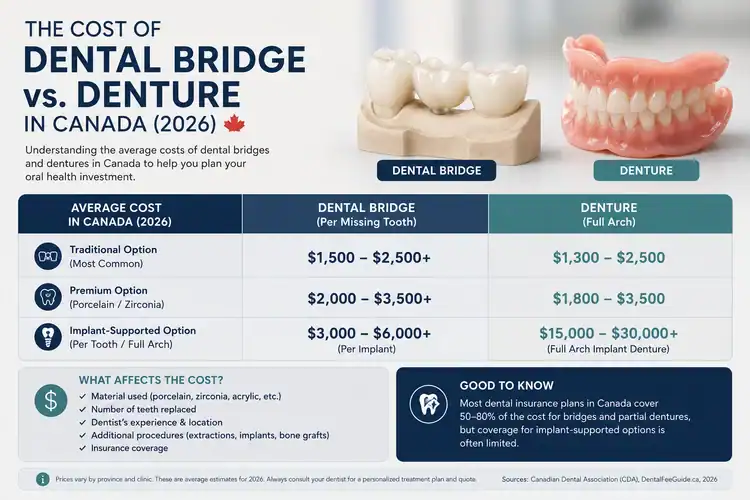
A removable partial denture usually has a lower initial cost. For patients in British Columbia, the 2026 BC Dental Association suggested fee guide lists the following amounts:
| Tooth Replacement | Typical 2026 Cost |
|---|---|
| Traditional dental bridge | Approximately $2,000–$5,000 |
| Provisional acrylic partial denture | From $417, plus applicable laboratory costs |
| Tooth-supported cast partial denture | About $1,129, plus applicable laboratory costs |
| Free-end cast partial denture | About $1,308–$1,426, plus applicable laboratory costs |
The final fee may change if the supporting teeth need fillings, crowns, root canal treatment, or periodontal care before the restoration is made. Dental offices set their own fees, and the BCDA guide provides suggested amounts rather than mandatory prices
When a Denture May Be Better Than a Bridge
A removable partial denture may be more suitable when many teeth are missing or the gaps are spread across the arch. It can replace several teeth with one appliance and may also restore gum tissue that has been lost.
A denture may also be preferred when:
- The teeth beside the gap are too weak to support crowns.
- There is no supporting tooth behind the missing area.
- The span is too long for a predictable tooth-supported bridge.
- Significant gum or bone volume needs replacement.
- The patient does not want healthy neighbouring teeth reshaped.
- Implant surgery is not appropriate.
- A more affordable initial treatment is required.
- Further tooth loss is expected, and the appliance may need modification.
A properly fitted denture remains a valid form of prosthodontics. It should not be viewed as an inferior treatment when the number or position of missing teeth makes a bridge unsuitable.
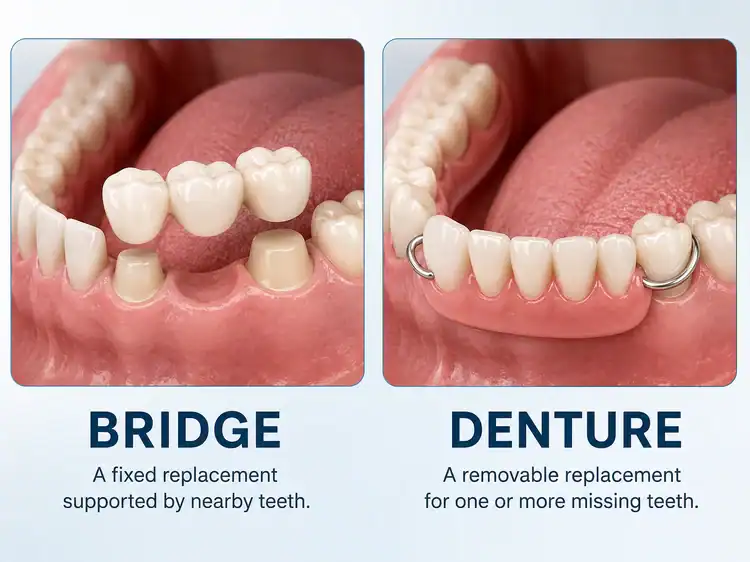
What Can Prevent You From Getting a Dental Bridge?
Some conditions may delay bridge treatment or rule out a traditional tooth-supported design.
Weak Supporting Teeth
Teeth with large cavities, fractures, short roots, or severe loss of tooth structure may not tolerate the forces placed on a bridge.
Active Gum Disease
The abutment teeth need stable gum and bone support. Active periodontal disease should be treated before a final bridge is considered.
Untreated Tooth Decay
Decay in an abutment tooth must be removed first. A tooth that appears usable on the surface may have more serious damage visible on a dental X-ray.
An Unsupported or Very Long Gap
A traditional bridge usually needs reliable support around the missing area. A gap at the back of the mouth may not have a natural tooth behind it. Long spans can place excessive force on the available abutments.
Poor Plaque Control
A bridge requires consistent cleaning around the crown margins and beneath the pontic. Persistent plaque can increase the risk of gum inflammation or decay around supporting teeth.
Heavy Grinding or Clenching
Strong bite forces can damage porcelain, loosen cement, or overload the supporting teeth. A bridge may still be possible, but the design and bite must be evaluated carefully.
Dental X-rays can help identify hidden decay and bone loss that cannot be assessed fully through visual examination alone.
An implant-supported bridge may be considered when natural teeth cannot support the restoration. Implant treatment requires an assessment of the jawbone, gums, medical history, and surgical suitability.
How a Dentist Chooses Between a Bridge and a Denture
The recommendation is based on the condition of the entire mouth rather than the missing space alone.
- Number and position of missing teeth: A short gap may suit a bridge. Several separate gaps may be restored more efficiently with a partial denture.
- Condition of the adjacent teeth: The dentist checks for decay, existing fillings, fractures, and root canal history. Teeth that already require crowns may be suitable bridge abutments.
- Gum and bone support: Healthy supporting tissues are essential for both options. A bridge depends heavily on the stability of the abutment teeth.
- Bite forces: The position of the bridge and the amount of pressure placed on it affect the design. Grinding or clenching may change the recommendation.
- Space and tissue loss: A denture can replace missing gum volume more effectively. A bridge usually works best when tissue loss is limited.
- Cleaning ability: A bridge must be cleaned beneath the artificial tooth. A denture must be removed and cleaned separately. The selected option should be manageable for the patient.
- Treatment preferences and cost: Some patients prefer a fixed restoration. Others prefer to avoid reshaping neighbouring teeth or need a lower initial cost.
- Possible implant treatment: A dental implant can support a single crown or bridge without relying on natural teeth beside the gap. Implants may also improve the stability of a removable denture.
The final recommendation may include a traditional bridge, resin-bonded bridge, implant-supported bridge, partial denture, or dental implant. Each option has different support requirements.
The healing process is also super important. The Cleveland Clinic website says:
“Recovery times vary from person to person and depend on several factors. On average, it takes one to two weeks for your teeth and gums to heal. But it can take a little longer for your new dental bridge to feel totally natural and comfortable.”
Conclusion
A dental bridge may be more suitable than a denture when one or a few neighbouring teeth are missing, and strong support is available beside the gap. It offers a fixed replacement with less movement, but it requires healthy abutment teeth and careful cleaning beneath the pontic.
Tsawwassen Family Dental can assess your remaining teeth, gums, bite, and dental X-rays before recommending a form of restorative dentistry. The aim is to select a restoration that provides reliable function without placing unnecessary strain on the supporting teeth.
FAQ
These answers address common questions patients have about bridges and removable partial dentures.
-
Is a Bridge More Comfortable Than a Partial Denture?
A bridge often feels less bulky because it is fixed and does not have a removable base. Comfort still depends on proper design, bite balance, and healthy supporting teeth.
-
How Many Missing Teeth Can a Dental Bridge Replace?
A bridge commonly replaces one to three neighbouring teeth. Longer bridges may be possible in selected cases, but they require stronger support and careful bite assessment.
-
Do the Teeth Beside the Gap Need to Be Healthy?
Yes. The abutment teeth need enough structure and bone support to carry the bridge. Decay or gum disease must be treated before placement.
-
Is a Dental Bridge Removable?
A fixed dental bridge cannot be removed by the patient. It is cemented to natural teeth or attached to dental implants.