


Many people in Canada worry about the cost of dental care, especially if they have no dental insurance. Maintaining your oral health is vital for overall well-being. The good news is that solutions exist to make dental care accessible and affordable, even without traditional coverage.

Dental Coverage Options Before You Pay Out of Pocket
Before assuming you have to pay the full cost yourself, it is worth checking whether you qualify for any type of dental support. In Canada, dental care may be paid for through government programs, private dental insurance, employer benefits, student plans, union plans, pension benefits, Indigenous health benefits, or clinic payment plans.
These options are different from one another. Some plans reduce the cost of regular checkups and cleanings. Others may help with fillings, extractions, dentures, root canals, gum treatment, or emergency care. Some programs are income-based, while others depend on your job, school, family benefits, or province.
How Much Does Dental Care Cost Without Insurance in BC in 2026?
Based on the 2026 BC Dental Association Suggested Fee Guide, common dental services in British Columbia may cost approximately:
| Dental service | Suggested 2026 fee |
|---|---|
| Routine exam and cleaning | $200–$333 |
| New-patient examination | $70–$150 |
| Emergency dental examination | $77 |
| Dental X-rays | $24–$130 |
| Tooth-coloured filling | $170–$610 |
| Root canal treatment | $670–$1,340 |
| Tooth extraction | $185–$485 |
| Porcelain or ceramic crown | $1,100 plus laboratory fees |
| Complete denture | $1,030–$1,130 plus laboratory fees |
| Partial denture | $420–$1,420 plus laboratory fees |
The routine exam and cleaning range includes a recall examination, approximately 30 to 60 minutes of scaling, and polishing. X-rays, fluoride treatment, or additional gum care may increase the total.
The cost of a filling depends on the tooth and the number of surfaces treated. Root canal fees depend on the number of canals and do not include the final filling or crown.
These are suggested provincial fees effective February 1, 2026, not fixed prices from Tsawwassen Family Dental. Dentists in British Columbia set their own fees, so ask for a written estimate before treatment.
How the Canadian Dental Care Plan Works in 2026
The Canadian Dental Care Plan can reduce dental costs for eligible Canadian residents who do not have access to private dental insurance. However, CDCP coverage does not always mean dental treatment will be completely free.
Who Qualifies for the CDCP?
You must meet all four requirements:
- You do not have access to private dental insurance through work, a family member, a pension plan, a student or professional organization, or a privately purchased plan.
- You and your spouse or common-law partner, when applicable, have filed your Canadian tax returns.
- Your adjusted family net income is below $90,000.
- You are a Canadian resident for tax purposes.
You may still be considered to have access to private insurance if you declined the plan, do not use it, or must pay a premium to join it.
How Much Does the CDCP Cover?
| Adjusted family net income | CDCP share of its established fee | Patient co-payment |
|---|---|---|
| Below $70,000 | 100% | 0% |
| $70,000–$79,999 | 60% | 40% |
| $80,000–$89,999 | 40% | 60% |
These percentages apply to the CDCP-established fees, not necessarily the full amount charged by the dental clinic. Patients may still need to pay the difference when the clinic’s fee is higher than the amount reimbursed by the CDCP.
What Dental Services Does the CDCP Cover?
Eligible services may include dental examinations, X-rays, cleanings, fluoride, fillings, root canal treatment, gum treatment, extractions, oral surgery, dentures, and crowns in approved cases. This makes it a useful option for patients who have delayed dental care because of the cost from dentists who accept CDCP.
Some treatments and services beyond established frequency limits require preauthorization. Approval is not automatic, so patients should confirm coverage and expected costs before treatment begins.
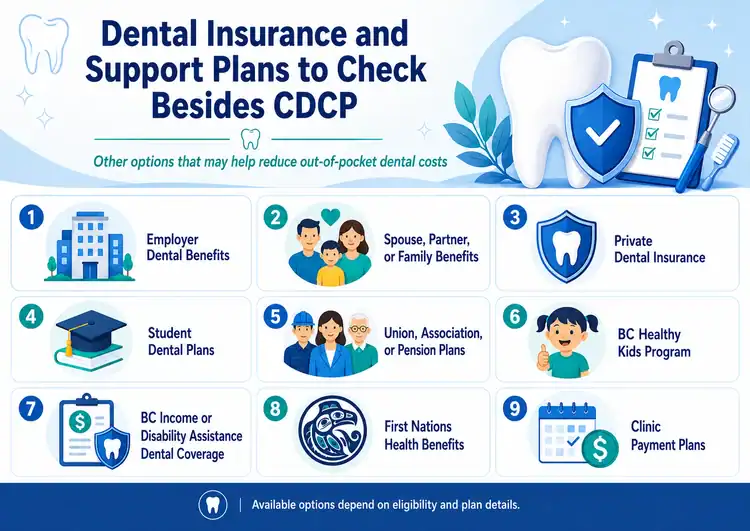
Other Dental Insurance and Support Plans to Check
CDCP is not the only option. Many patients who think they have no dental insurance may still have access to another type of dental coverage.
Employer Dental Benefits
Some workplaces offer dental benefits as part of an extended health plan. These plans often cover preventive care such as exams, cleanings, and X-rays. Depending on the policy, they may also cover part of the cost of fillings, extractions, root canals, crowns, bridges, dentures, or orthodontic treatment.
Spouse, Partner, or Family Benefits
You may also have access to dental coverage through a spouse, common-law partner, or parent’s benefits plan. This is common for families, students, and young adults who may still be listed as dependents. Before paying out of pocket, it is worth checking whether another family member’s plan can cover part of your dental care.
Private Dental Insurance
Private dental insurance can be purchased directly from an insurance provider. These plans may be useful for people who want help managing regular dental expenses. However, patients should compare the monthly premiums, annual maximums, waiting periods, deductibles, exclusions, and coverage percentages before buying a plan. In some cases, paying directly for preventive visits may cost less than a private plan. In other cases, a plan may help if larger treatment is expected.
Student Dental Plans
Many colleges and universities include dental coverage in student health plans. Students sometimes forget they already pay for these benefits through school fees. Student dental plans may help with cleanings, exams, X-rays, fillings, and other basic dental services.
Union, Association, or Pension Plans
Some unions, professional associations, alumni groups, and pension plans include dental benefits. Retired patients, self-employed professionals, and union members should check whether they have access to group dental coverage through one of these sources.
BC Healthy Kids Program
The BC Healthy Kids Program provides basic dental coverage for children under 19 in families that qualify through MSP Supplementary Benefits.
Eligible children can receive up to $2,000 toward basic dental services every two years. Covered services include examinations, X-rays, cleanings, fillings, and extractions. Emergency treatment for immediate pain relief may still be available after the regular limit has been reached, but orthodontic treatment is not covered.
Parents should provide the child’s Personal Health Number and ask the dental clinic to confirm eligibility through Pacific Blue Cross before treatment.
BC Income or Disability Assistance Dental Coverage
Eligible adults receiving disability assistance or certain health supplements may receive up to $1,000 in basic dental coverage over two calendar years. Coverage may include preventive care, fillings, extractions, partial dentures, and crowns or bridges in certain circumstances.
Children under 19 in families receiving assistance may receive up to $2,000 over two calendar years. An additional amount of up to $1,000 per year may be available when dental treatment must be completed in a hospital under general anesthesia.
The ministry pays eligible fees directly to the dental provider. However, patients may still be responsible for charges above the ministry’s maximum payment, so coverage should be confirmed before treatment.
First Nations Health Benefits
Eligible First Nations Health Authority clients in British Columbia may have coverage for dental examinations, X-rays, cleanings, fillings, gum treatment, root canals, crowns, veneers, bridges, dentures, oral surgery, and certain orthodontic services.
Some services require preauthorization or are subject to clinical, age, and frequency limits. FNHA dental benefits are administered in partnership with Pacific Blue Cross, so patients should confirm their available coverage before treatment begins.
Clinic Payment Plans
If you do not qualify for public coverage or insurance, a clinic payment plan may help you manage treatment costs. Payment plans can divide the cost of care into smaller payments, which can be especially helpful for larger treatments such as crowns, dentures, bridges, root canals, or multiple fillings.
Still Searching For Dental Care?
If you are looking for affordable dental care options, contact a trusted dental clinic to learn about flexible payment plans and personalized treatment solutions. Quality dental care can still be accessible, even without insurance coverage.
Exploring Affordable Dental Care Options
After checking government programs, private insurance, employer benefits, family coverage, student plans, and BC-specific supports, there are still other ways to make dental care more affordable. Community clinics, dental schools, payment plans, and preventive care can all help reduce costs, especially when used together.
Community Clinics and Dental Schools
Dental schools and community clinics may offer lower-cost dental services for some patients. In dental schools, students provide care under the supervision of licensed dental professionals, which can make certain treatments more affordable. Community health centres may also offer limited dental support depending on location, eligibility, and available programs. These options can be helpful, but they may have longer wait times or limited appointment availability.
Dental Payment Plans and Financing
Dental payment plans can help patients start needed treatment without paying the full amount upfront. Instead of delaying care, the total cost may be divided into smaller payments. This can be useful for treatments such as crowns, bridges, dentures, root canals, gum therapy, or multiple fillings.
Before choosing a payment plan or third-party financing, ask about the monthly payment amount, interest rate, repayment period, approval requirements, and total cost. This helps you understand whether the plan truly fits your budget.
Read more: Dental insurance options
Handling Dental Emergencies Without Insurance
Dental emergencies can happen unexpectedly, and the thought of emergency dental care without insurance can be daunting. It is crucial to address urgent issues promptly to prevent further complications. Ignoring severe pain or injury can lead to more extensive and expensive treatments later.
If you experience a dental emergency, contact our clinic immediately. We can assess your situation and discuss the most critical steps. We work with patients to find solutions, even for urgent needs. Our goal is to alleviate pain and address the immediate problem. You can learn more about handling dental emergencies on our website.
In case of CDCP, the CDA website says:
“The federal government has committed to rolling out the CDCP coverage in stages. Health Canada is using a staggered approach to patients’ eligibility for care based on their registration date and age cohort.”
Dental Treatments You Should Not Delay, Even Without Insurance
Many Canadians without dental insurance postpone treatment because they worry about costs. However, delaying certain dental problems often leads to more pain, infections, and significantly higher expenses later.
Tooth infections, cavities, gum disease, and cracked teeth rarely improve on their own. A small cavity that could have been treated with a simple filling may eventually require a root canal or extraction if ignored for too long. Gum inflammation can also progress into periodontal disease, which may lead to tooth loss and more complex treatment needs.
Some dental issues that should never be delayed include:
- Persistent tooth pain
- Swelling or signs of infection
- Bleeding or severely inflamed gums
- Broken or cracked teeth
- Loose fillings or crowns
- Difficulty chewing or jaw pain
Seeking care early often lowers total treatment costs and helps prevent emergencies. At Tsawwassen Family Dental, we help patients prioritize urgent dental concerns while discussing affordable treatment options that fit their budget.
Ways to Reduce Out-of-Pocket Dental Expenses
If you do not have dental insurance, the most helpful thing is to check your options in the right order. Some patients qualify for public coverage, some already have access to benefits through work or family, and others may need a private plan or clinic payment arrangement. The table below can help you decide where to start before paying the full cost yourself.
| Where to Start | Who This Usually Helps | What It May Reduce | What to Ask Before Treatment |
|---|---|---|---|
| Canadian Dental Care Plan | Patients without private dental insurance who meet the income rules | Part of the cost of exams, cleanings, fillings, dentures, root canals, gum care, oral surgery, and other eligible services | Am I eligible, is this treatment covered, and will I still have a co-payment or extra charge? |
| Workplace dental benefits | People whose employer offers extended health benefits | Routine visits, X-rays, fillings, and sometimes larger treatments | What percentage is covered, what is my yearly limit, and do I need to pay first and claim later? |
| Spouse, partner, or family coverage | Spouses, partners, students, and dependents listed on another person’s plan | Some or most of the cost of regular dental care, depending on the plan | Am I already listed as a dependent, and can this plan be combined with another benefit? |
| Private dental insurance | Patients who want more predictable dental costs | A portion of regular checkups, cleanings, and selected treatments | Are there waiting periods, yearly maximums, exclusions, or limits on major dental work? |
| Student dental plans | College and university students | Preventive care and basic treatments included in some student health plans | Is dental coverage included in my student fees, and what services are covered? |
| Union, association, or pension benefits | Union members, retirees, professional members, and some self-employed patients | Group dental benefits that may not come directly from an employer | Does my membership or pension plan include dental, and what is the annual maximum? |
| BC Healthy Kids Program | Eligible low-income families with children in British Columbia | Basic dental care for children, such as exams, X-rays, cleanings, fillings, and extractions | Does my child qualify, and which services are covered before the appointment? |
| BC income or disability assistance dental coverage | Eligible BC residents receiving income or disability assistance | Basic or emergency dental services, depending on program rules | Is the treatment covered, and does it need approval before work begins? |
| First Nations Health Benefits | Eligible First Nations patients in British Columbia | Approved dental services, depending on benefit rules and treatment type | Is preauthorization needed, and are there frequency limits for this service? |
| Clinic payment plans | Patients paying out of pocket or covering a remaining balance | The pressure of paying the full amount upfront | What will I pay monthly, is there interest, and what is the total repayment amount? |
Taking care of dental problems early is usually far less expensive than waiting for severe pain or emergency treatment. Even without private insurance, combining preventive care with available financial support can make regular dental care more affordable in Canada.
Prioritizing Preventive Dental Care
The best way to manage dental costs when you have no dental insurance is to prevent problems before they start. Preventive dental care is often less expensive than restorative treatments. Regular check-ups and cleanings can catch small issues early, before they become painful and costly emergencies.
Visiting the dentist for routine exams allows us to monitor your oral health, offer advice on proper brushing and flossing techniques, and apply preventative treatments like fluoride or sealants. Investing in consistent preventative care can save you money and discomfort in the long run.
How Regular Dental Visits Save Money Over Time
Skipping routine dental visits may seem like a way to save money, but it often leads to larger expenses in the future. Regular dental exams help identify cavities, gum disease, enamel wear, and infections before they become advanced problems requiring more complex treatment.
Professional cleanings also remove plaque and tartar buildup that brushing and flossing alone cannot eliminate. Preventing gum disease and tooth decay early reduces the likelihood of needing costly procedures such as root canals, crowns, gum therapy, or tooth replacement.
Routine visits also allow dentists to monitor changes in your oral health over time. This proactive approach helps patients avoid sudden dental emergencies and maintain healthier teeth for longer.
For individuals without insurance, preventive care is often the most cost-effective long-term strategy for maintaining oral health while minimizing unexpected dental expenses.
Getting Affordable Regular Dental Care in Canada
Getting affordable regular dental care in Canada starts with knowing which support options apply to you. If you do not have private dental insurance, check CDCP eligibility first. Then review whether you may have access to coverage through work, a spouse or family member, school, a union, a pension plan, BC Healthy Kids, income or disability assistance, or First Nations Health Benefits.
If none of these options apply, ask your dental clinic about payment plans, phased treatment, and which dental issues should be treated first. Even without insurance, it is often possible to manage dental care in a way that protects your health and avoids larger emergency costs later.
At Tsawwassen Family Dental, our team can help you understand your options and plan treatment based on your needs, priorities, and budget.
FAQ
Here are answers to common questions about dental care when you have no dental insurance:
-
What is the Canadian Dental Care Plan (CDCP)?
The CDCP is a new government program that helps eligible Canadian residents access essential dental care by covering a portion of their treatment costs. It aims to reduce financial barriers for those without private insurance.
-
How do I know if I’m eligible for the CDCP?
Eligibility for the CDCP is primarily based on your adjusted family net income and whether you have access to private dental insurance. You can find detailed criteria and application information on the Health Canada website.
-
Are there payment plans available for dental services?
Yes, many dental clinics, including Tsawwassen Family Dental, offer in-house payment plans or work with third-party financing companies to help you spread the cost of treatment over time. Discussing these options with your clinic is a good first step.