



If your household income is under $90,000 and you do not have private dental insurance, the CDCP is often the more affordable option, providing essential dental coverage with little to no co-payments. However, if you anticipate major or elective dental work, prefer complete freedom in choosing your providers, or already have private coverage, individual dental insurance may offer greater flexibility. The best option depends on your income, dental needs, and preferred providers.
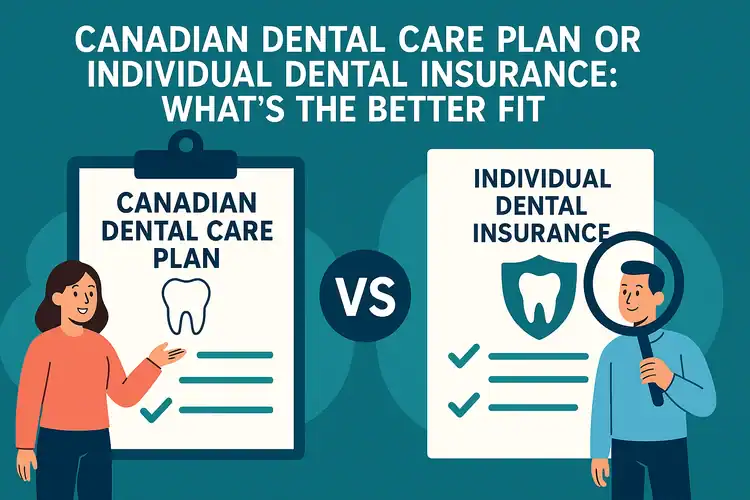
This article explains how the CDCP works, who qualifies, and what services are covered. You’ll also learn how private dental insurance functions, how reimbursement works, and the limitations to expect. Finally, we’ll compare the advantages and drawbacks of both options to help you make an informed choice.
What is the Canadian Dental Care Plan (CDCP)?
The CDCP is a federal program designed to make dental care more accessible for Canadians without existing dental insurance. It helps reduce out-of-pocket costs for routine and restorative care, especially for low- and moderate-income households.
Eligibility is based on your tax filings and your adjusted family net income. Patients receive coverage through Sun Life, and providers must agree to work within the plan’s billing rules for direct reimbursement.
Eligibility Criteria and Income-Based Co-Payments
Eligibility for the Canadian Dental Care Plan (CDCP) is determined through a combination of income level, insurance status, and tax requirements. To qualify, applicants must have an adjusted family net income under $90,000, must not have access to private or employer-provided dental insurance, and must be Canadian residents for tax purposes. Applicants are also required to file taxes annually, since eligibility tiers are determined using the most recent tax assessment.
The CDCP uses a structured, income-based cost-sharing model to keep dental care accessible while ensuring sustainability. Co-payments vary by income tier, allowing lower-income households to receive more comprehensive support.
Co-payment tiers include:
| Adjusted Family Net Income | Co-Payment / Coverage |
|---|---|
| Under $70,000 | No co-payment (100% coverage) |
| $70,000 – $79,999 | 40% co-payment |
| $80,000 – $89,999 | 60% co-payment |
Beyond these co-payment rules, some patients may still face additional costs if their dentist charges more than the CDCP-approved reimbursement rates. While many dental providers align their fees with CDCP guidelines, others may require patients to pay the remaining difference. For this reason, beneficiaries are encouraged to confirm their dentist’s participation level and billing structure before starting treatment.

What Services Are Covered and How Reimbursement Works
Coverage under the CDCP isn’t that complicated. In simple terms, CDCP covers crucial procedures that are essential to the patient and their oral health.
The services include:
- Dental exams
- Teeth cleanings
- X-rays
- Dental fillings
- Extractions
- Root canals
- Removable dentures
The CDCP follows a fee guide, which determines the charges for covered services. If a dentist charges more than the fee guide, patients are responsible for paying the difference. While the plan helps reduce out-of-pocket expenses by allowing providers to bill Sun Life directly, it’s important to confirm that your dentist participates in the plan. Not all dentists participate in CDCP, which can limit your provider options depending on your location.
Read more: CDCP Root Canal Coverage
How Individual Dental Insurance Works
Individual dental insurance uses monthly premiums rather than income-based eligibility. This approach offers greater freedom and typically broader coverage, especially for major restorative or elective treatments such as crowns, dental bridges, orthodontics and even dental implants. Unlike CDCP, private insurance does not limit you to participating providers, which means you can continue visiting your preferred dentist without switching clinics.
Reimbursement varies by plan tier. Basic plans often cover preventive care, while enhanced plans may cover higher-cost procedures at better reimbursement rates. Waiting periods are common for major treatments, and annual maximums can limit how much support you receive in a policy year.
Here is what the Summit website has said about what private coverage doesn’t do:
“Basic hospital and physician care that provincial plans offer will not be substituted with private insurance. It is not a replacement for the emergency services or fundamental physician visits, which are publicly covered. Premiums, deductibles, and co-pays also imply that you can still pay for care, but private plans can take care of those; however, they are not free healthcare.”
Read more: CDCP Dental Implant Coverage for Seniors
Pros and Cons of the CDCP vs. Individual Dental Insurance
Take a look at the table below to have a great understanding of the comparison between the pros and cons of CDCD vs. individual dental insurance with the help of structured data:
| Category | Pros | Cons |
|---|---|---|
| Canadian Dental Care Plan (CDCP) | 1. Significantly reduces dental costs for uninsured and lower-income Canadians 2. No monthly premiums 3. Direct billing simplifies payments 4. Covers many essential dental procedures | 1. Only available at clinics that accept CDCP billing 2. Some treatments have limited or conditional coverage 3. Possible extra charges if provider fees exceed CDCP rates 4. Income-based co-payments may still apply |
| Individual Dental Insurance | 1. Broad coverage, including major and elective procedures 2. Freedom to visit any dentist 3. Predictable reimbursement structure 4. Ideal for individuals with ongoing or complex dental needs | 1. Monthly premiums are required regardless of usage 2. Waiting periods for major procedures 3. Annual maximums may cap coverage 4. Premiums may increase over time |
The key here is to choose your insurance based on many different factors that can make a change, and also bring out the best benefits based on your requirements.
Discover more: Dental Coverage in British Columbia for Seniors
How to Choose the Right Option for Your Situation
Your ideal plan depends on your income, anticipated dental needs, and preferred level of provider flexibility. If you primarily require routine care and meet CDCP income thresholds, the government plan offers strong value with minimal financial burden. Individuals who don’t mind switching providers or who have generally simple dental needs that aren’t a dental emergency often benefit the most from CDCP coverage.
If, however, you expect more complex treatment, value the ability to select any dentist, or want access to elective procedures, private insurance may better meet your long-term needs. Consider factors such as premium affordability, the likelihood of needing major dental work, and whether your current dentist participates in the CDCP.

Tips for Choosing the Best Insurance
As we mentioned throughout the article, the key point is to choose the insurance based on your needs and, of course, your situation to get the best out of your dental benefits so you are rest assured.
But to make the best decision and choose the most suitable option for you and your loved ones, we advise you to take a look at the key decision factors below, considering that you can make a better decision:
- Your income level and CDCP eligibility
- Expected dental care needs in the next 1–3 years
- Whether your preferred dentist participates in CDCP
- Your comfort with monthly premiums versus co-payments
- Need for major restorative or elective treatments
Evaluating these elements helps determine which option aligns best with your priorities, especially if you are looking for something special and distinctive.
Need help deciding Which Insurance to Choose?
Reach out now for expert assistance and personalized coverage recommendations.
You can rely on us to help evaluate both plans based on your situation to get the possible outcome.
Make an Informed Choice About Your Ideal Dental Coverage
Both the Canadian Dental Care Plan and private dental insurance offer meaningful benefits, but they serve different needs. CDCP is excellent for routine and essential care at low cost, particularly for those without existing coverage. Meanwhile, private insurance provides more comprehensive protection, wider provider choice, and greater flexibility for major or specialized procedures.
If you’re unsure which option is right for you, you can rely on the best dentistry in Delta to help evaluate both plans based on your income, dental history, and future needs. Contact us today for personalized guidance and expert support in choosing the most effective dental coverage.
FAQ
-
Can I have both CDCP and private dental insurance at the same time?
No. You must not have access to private insurance to qualify for CDCP.
-
Does CDCP cover major dental work like crowns or dentures?
Some major procedures are covered, but they may be limited or require clinical justification.
-
What if my dentist doesn’t participate in the CDCP?
You may need to find a participating provider unless your dentist agrees to bill Sun Life on a claim-by-claim basis.
Still unsure or have questions?
Leave a comment below and let us know your situation
We’re here to help!